Al-Mihdhar Historic Mosque
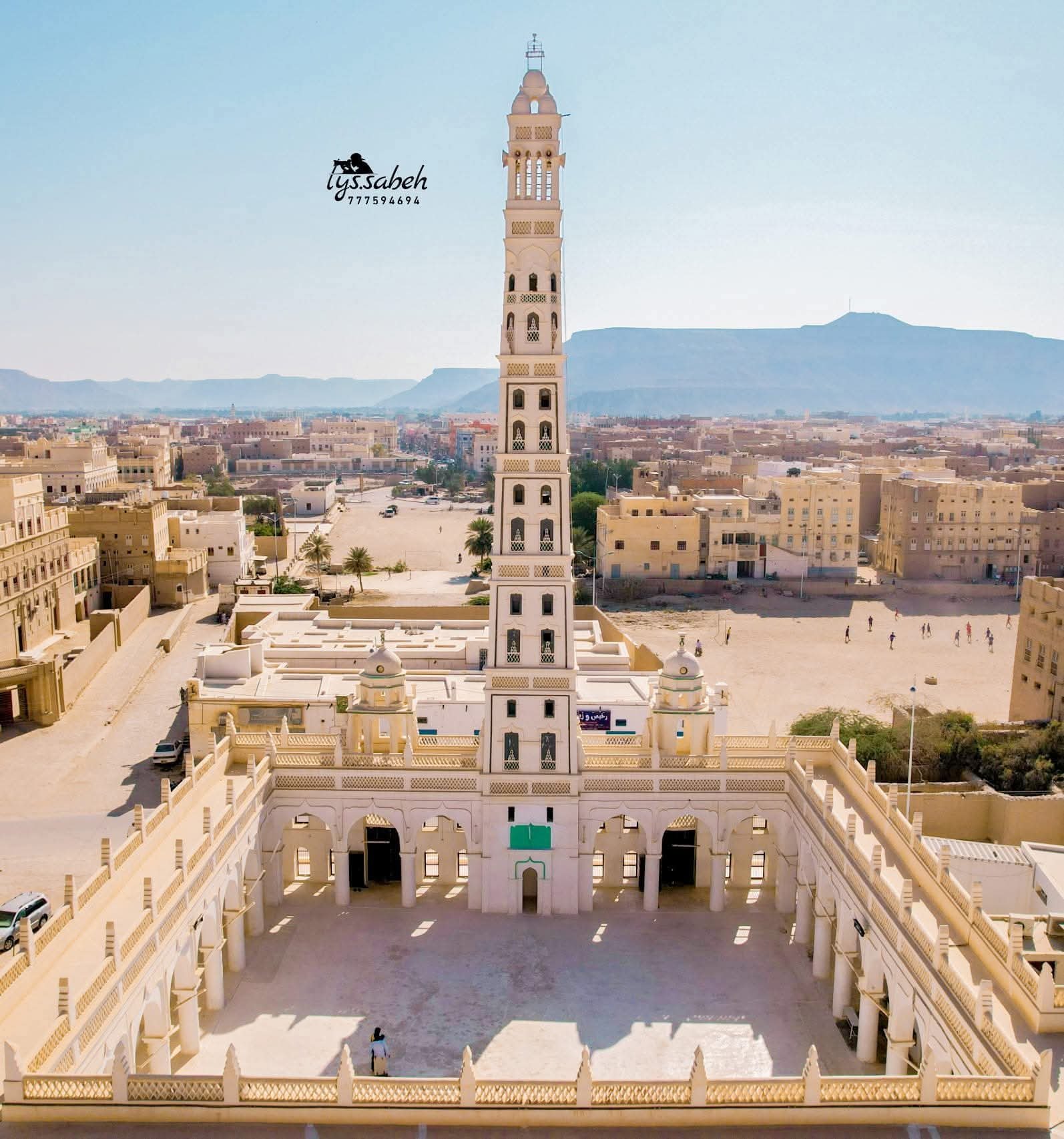
The historic Al-Mihdhar Mosque in the city of Tarim, Hadramout Governorate, is one of Yemen’s most prominent Islamic and architectural landmarks and a distinctive symbol of Hadrami mud-brick building arts. It is renowned for its towering white minaret, which stands about 53 meters high and is considered one of the most famous mud-brick minarets in the world. The mosque’s origins date back to the ninth century AH, and its name is associated with the scholar Umar al-Mihdhar bin Abdul Rahman al-Saqqaf. It acquired its prominent architectural form during renovation work in the early twentieth century. The mosque embodies Tarim’s religious and scholarly standing, as well as the skill of Hadrami architects in constructing mud-brick buildings.
Al-Mihdhar Mosque.. A Mud Minaret Recounts the History of Scholarship and Architecture in Tarim
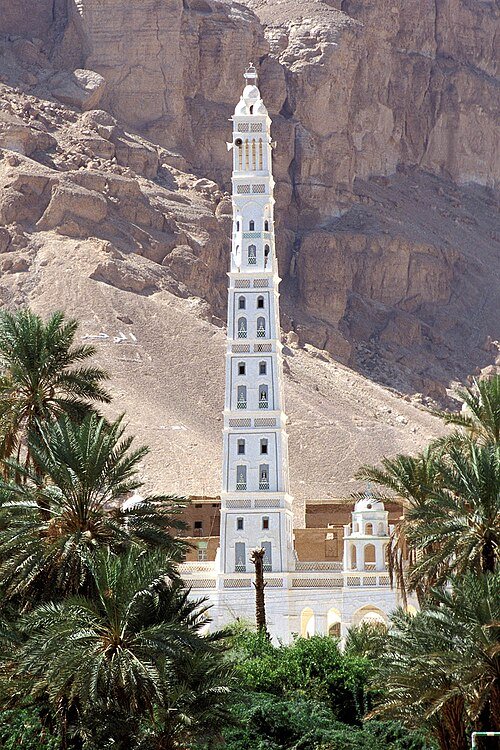
In the heart of the historic city of Tarim in Wadi Hadramout, the white minaret of Al-Mihdhar Mosque rises above traditional buildings, forming one of Yemen’s most distinctive architectural scenes and bearing witness to centuries of religious and scholarly presence and Hadrami engineering artistry.
The mosque brings together the depth of its origins and the beauty of its construction. Its roots date back to the ninth century AH, while its current architectural form reflects phases of development and renovation, most notably those the city underwent in the early twentieth century.
Geographical Location and Historical Significance
Al-Mihdhar Mosque is located in the center of the city of Tarim in Hadramout Governorate, in the eastern part of Wadi Hadramout, within a historic urban setting known for its mosques, religious schools, mud-brick homes, and palaces.
The mosque has been closely linked to the city’s religious and cultural identity. For centuries, the city has been known as a center for Islamic jurisprudence and education, and a destination for students of knowledge from various regions.
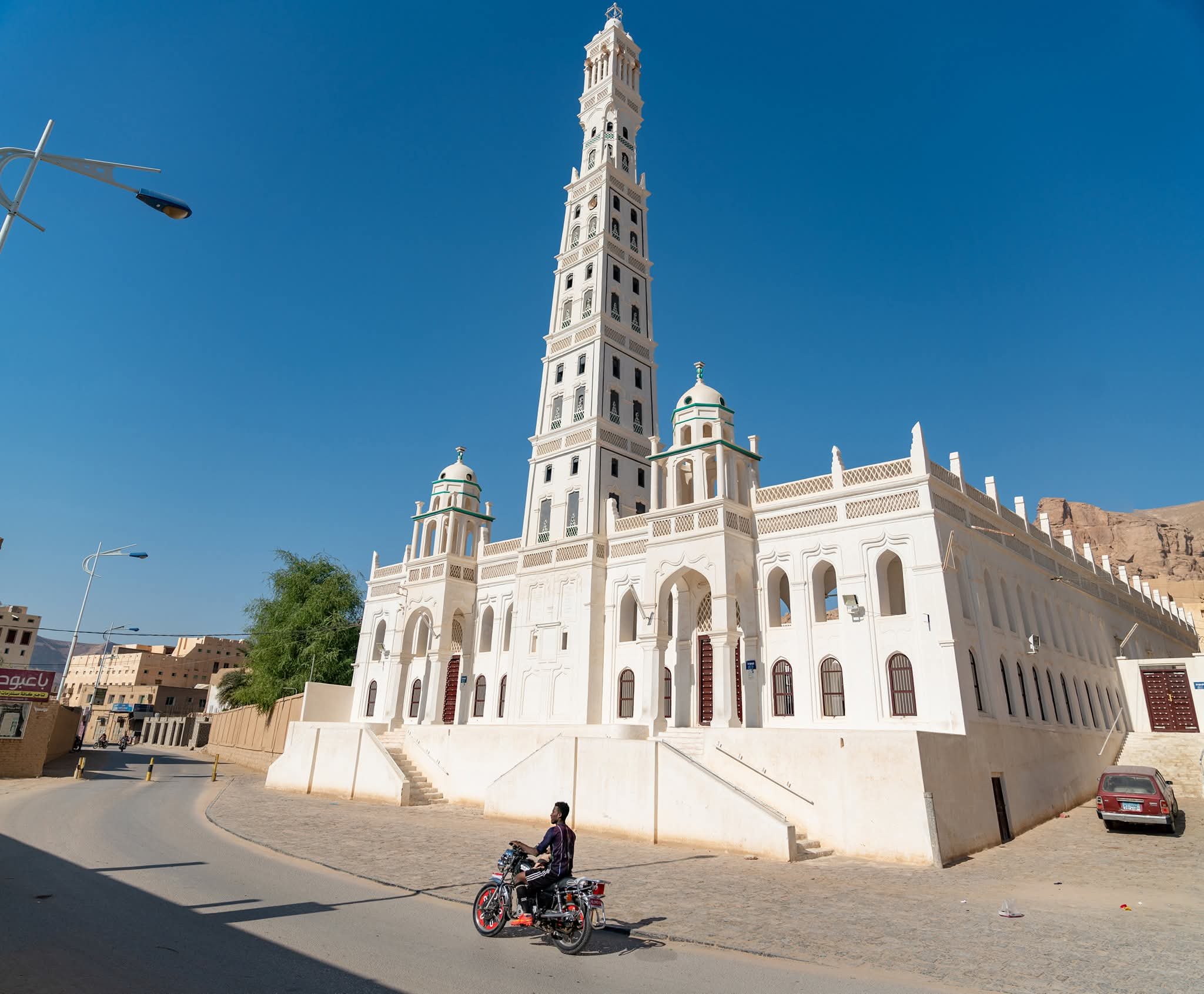
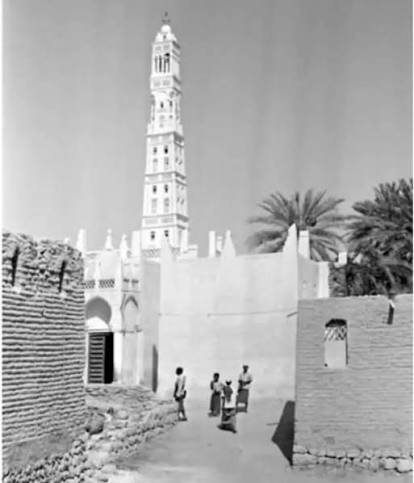
The mosque’s location is distinguished by its integration into the old urban fabric, with traditional buildings and alleys surrounding it. Its minaret rises above neighboring buildings, forming a prominent visual landmark that can be seen from various parts of the city.
Founding and Historical Roots
The founding of Al-Mihdhar Mosque is attributed to the scholar Umar al-Mihdhar bin Abdul Rahman al-Saqqaf, who died in 833 AH, corresponding to 1429 AD, and was one of the religious figures associated with Tarim’s scholarly and social history.
In its early days, the mosque was a modest building compared with its present form, before undergoing successive expansions and renovations in response to the city’s urban and religious needs.
Over time, the mosque became part of Tarim’s religious and urban landscape and retained the name associated with its original founder, despite the changes to its structure and layout.
The mosque underwent an important phase of reconstruction and development in the early twentieth century, around 1333 AH, corresponding to 1914 AD. This phase was associated with the construction of its famous minaret and the emergence of the architectural features for which it is known today.
Al-Mihdhar Minaret.. Exceptional Mud-Brick Engineering
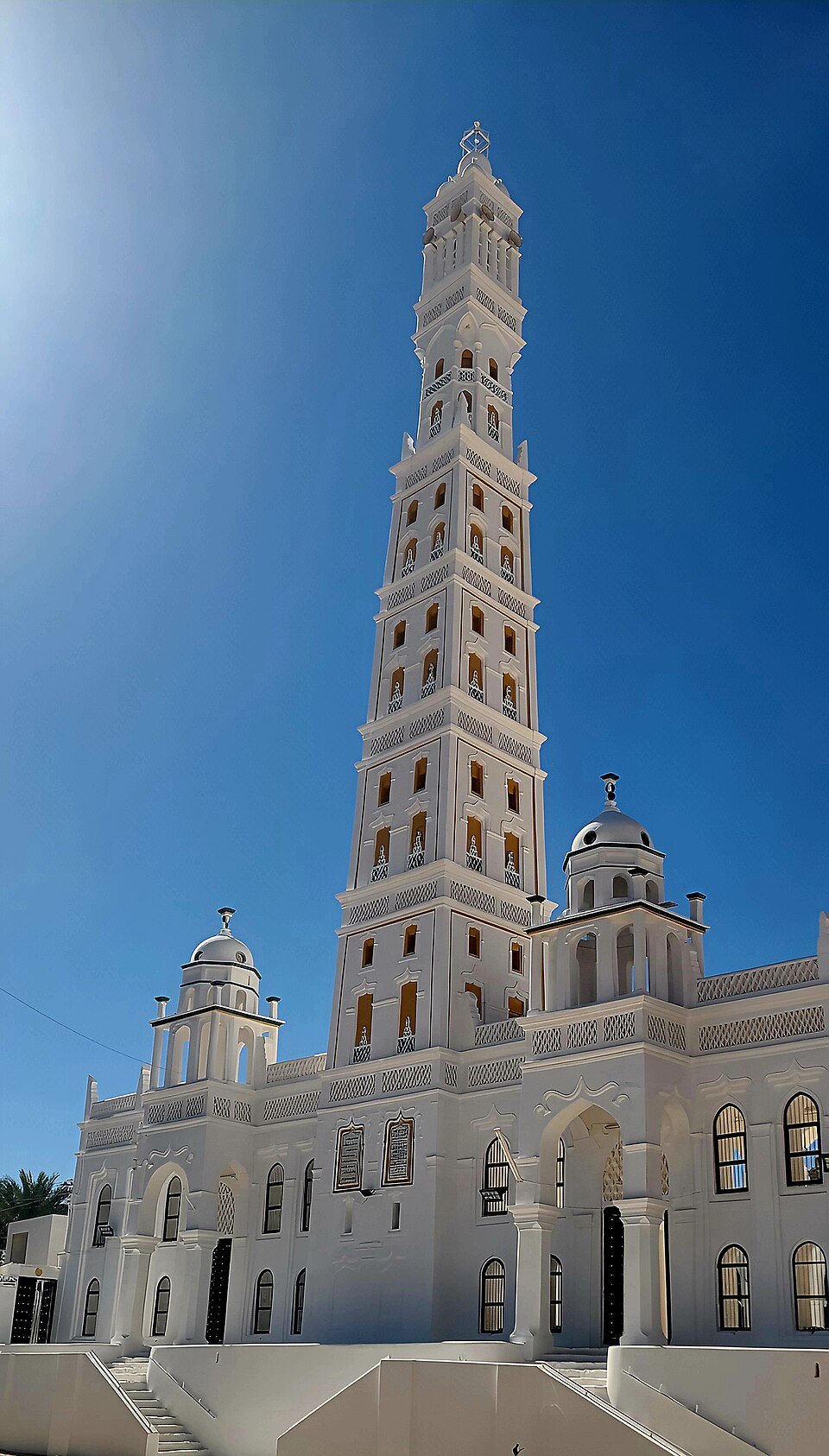
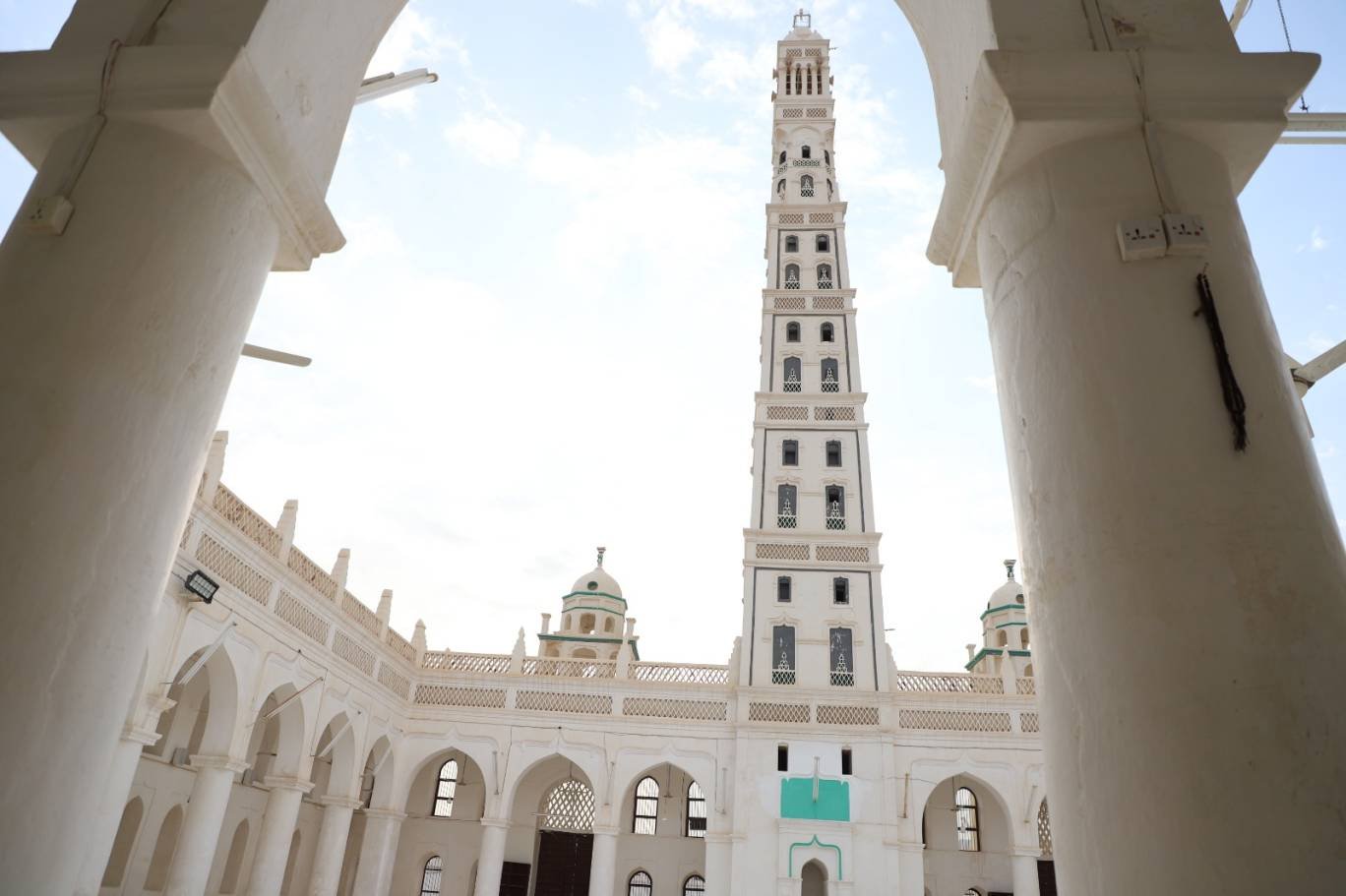
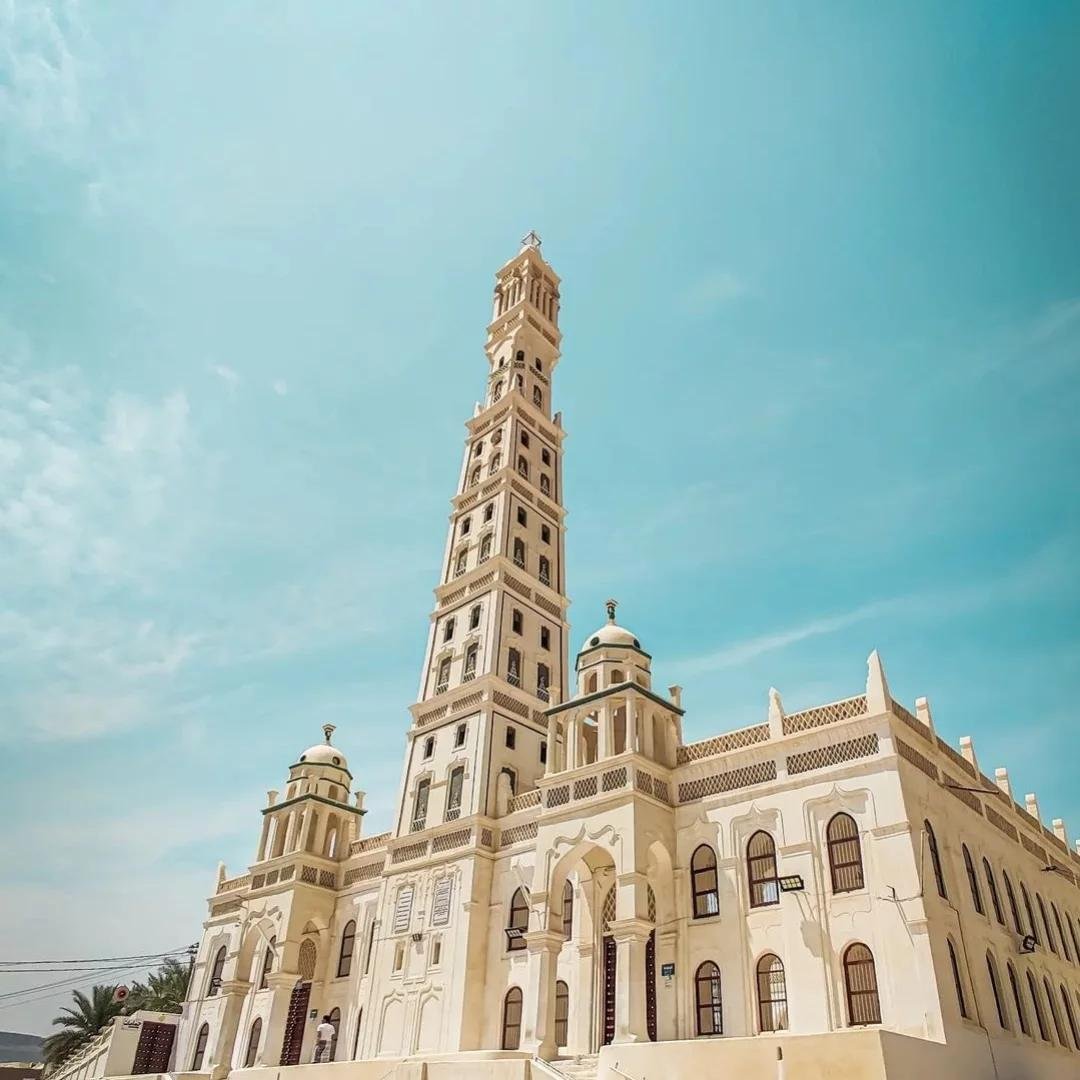
The minaret of Al-Mihdhar Mosque is its most prominent and famous architectural feature. It stands about 53 meters high and is widely described as one of the tallest minarets in the world built from unfired mud brick.
The minaret rests on a square base, then rises in a stepped vertical form distinguished by its symmetry and slenderness, with its dimensions gradually narrowing toward the top.
Mud brick was used in its construction, along with traditional local materials, while its façades were covered with a white layer of plaster, giving it its distinctive appearance and helping to protect its exterior surfaces.
Architectural openings and decorations are distributed symmetrically across the minaret’s body, while an internal staircase leads to its upper levels, in a design that reflects the skill of traditional builders and their ability to work with great heights.
The minaret’s exceptional value stems from its use of local building materials and traditional engineering techniques, without recourse to the concrete and steel frameworks used in modern structures.
The Designer and Builder.. Creativity by the People of Hadramout
The design of Al-Mihdhar Minaret is associated with the Hadrami writer and poet Abu Bakr bin Shihab, to whom historical and architectural sources attribute the development of its engineering concept.
The construction work is also attributed to master builder Awad Suleiman Afif, one of the Hadrami builders renowned for their skill in mud-brick architecture.
The combination of the architectural concept and local craftsmanship helped produce a distinctive structure that brings together engineering precision and aesthetic harmony.
The minaret thus reflects a phase in the development of architectural arts in Tarim, when builders used inherited knowledge of natural materials to erect tall structures of considerable architectural value.
Interior Layout and Islamic Decorations
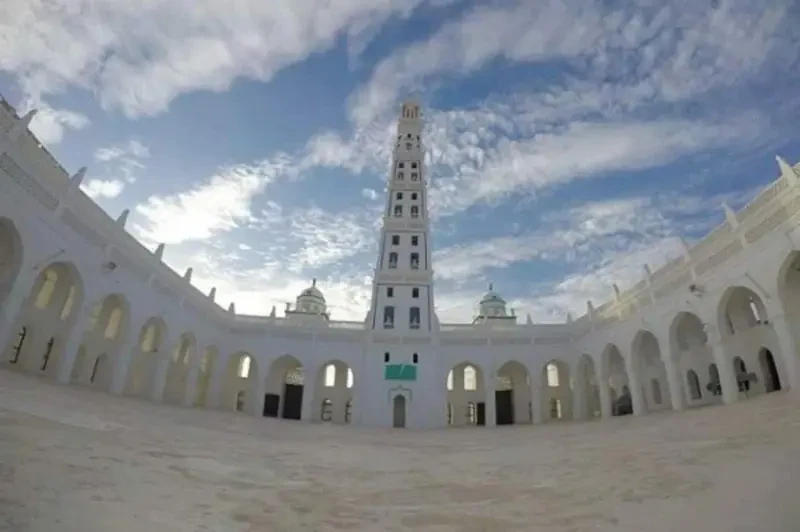
The mosque consists of an open courtyard surrounded by prayer arcades, with the qibla arcade being the deepest and most spacious.
The arcades rest on columns supporting harmonious architectural arches, while some mihrabs and interior features are adorned with plaster decorations in geometric, floral, and calligraphic forms.
This layout reflects the characteristics of traditional Islamic architecture, which combines functional simplicity with decorative beauty while taking into account the needs for lighting, ventilation, and movement inside the mosque.
The mosque also includes facilities associated with religious services, including ablution areas and adjoining facilities, some of which have undergone changes as the building developed.
Religious and Scholarly Significance
The significance of Al-Mihdhar Mosque extends beyond its architectural value to its connection with the religious and scholarly history of Tarim, which for centuries has been home to schools, religious schools, libraries, and scholarly gatherings.
The mosque stands as one example of the role played by mosques in Hadrami society as places of worship, learning, and social interaction.
Its continued presence within the city’s urban fabric also reflects the close relationship between religious institutions and residents’ daily lives, a relationship that has helped shape Tarim’s cultural identity.
Tourism and Heritage Value
Al-Mihdhar Mosque has become one of the most famous landmarks associated with images of the city of Tarim, particularly its white minaret, which features in documentary materials and tourism photographs of Wadi Hadramout.
The landmark attracts the interest of researchers in the history of Islamic architecture and those interested in mud-brick building techniques, as well as visitors wishing to learn about the city’s cultural and religious heritage.
Its value is evident as a model of traditional architecture that has managed to combine religious function, local identity, and engineering creativity.
Preserving the Mosque and Safeguarding Its Architectural Identity
Historic mud-brick buildings require ongoing care, given the susceptibility of their natural materials to rain, humidity, and climatic changes, making regular maintenance essential to preserving their structural integrity.
Protecting Al-Mihdhar Mosque is especially important because of the height of its minaret and the nature of the building materials used in it, in addition to the historical and decorative value of its architectural features.
Preserving this landmark requires adherence to restoration materials and methods suited to the characteristics of mud-brick architecture, and drawing on the expertise of traditional builders and specialists in the maintenance of archaeological structures.
Al-Mihdhar Mosque.. The Memory of Tarim and a Symbol of Its Civilization
Al-Mihdhar Mosque remains more than just a historic mosque. It bears witness to the scholarly and religious traditions of the city of Tarim and embodies the Hadrami people’s expertise in transforming mud into towering architectural structures of exceptional beauty.
Through its white minaret, traditional arcades, and history spanning centuries, the mosque continues to stand as a symbol of Hadrami identity and one of the most prominent examples of Yemen’s rich Islamic architectural heritage.
Preserving this landmark is a cultural and historical responsibility, safeguarding a civilizational legacy that brings together knowledge, art, and architecture and deserves to remain in the memory of future generations.
Photo gallery