745 Divorce Cases in One Year at West Mukalla Court… What Is Happening Behind the Doors of Married Life?
Behind every divorce case is a family story that has reached a crossroads. But when official statistics show that 745 divorce cases were recorded in one year at the West Mukalla Primary Court, the figure goes beyond being mere judicial data, raising pressing social questions about the state of marital relationships and the reasons that lead hundreds of families to separate.
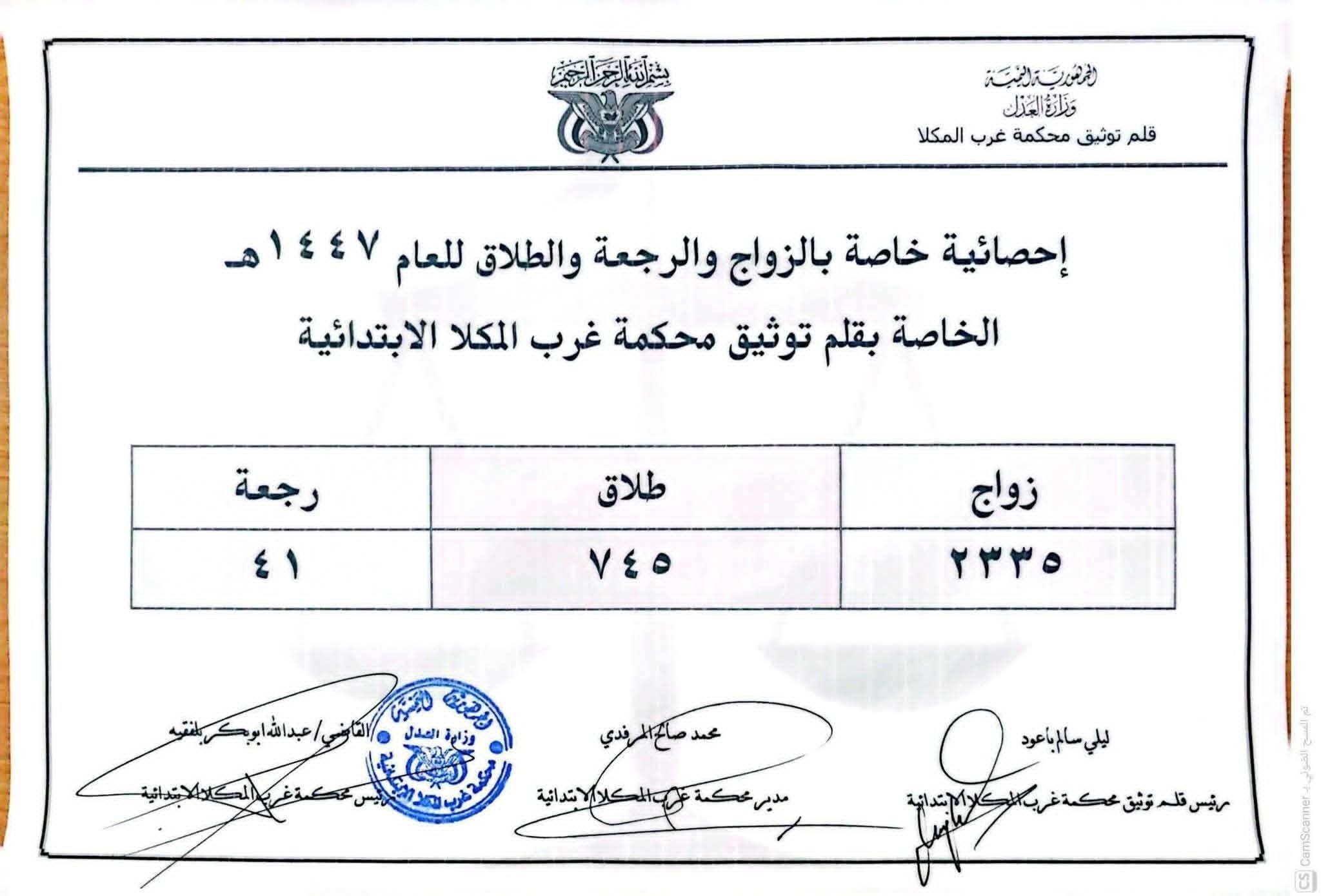
Official statistics issued by the documentation office at the West Mukalla Primary Court for the Hijri year 1447 AH showed that 2,335 marriages were documented, compared with 745 divorce cases and 41 cases of marital reconciliation, figures that warrant a deeper examination of family life rather than simply counting marriage and separation contracts.
A numerical comparison shows that the recorded divorce cases amounted to about 32% of the marriage contracts documented during the same period. This does not mean that one-third of the new marriages ended in divorce, as the separations may involve marriages entered into in previous years.
But the more important question is: What drives a husband and wife who have shared a life together to decide to divorce? Are economic circumstances and the pressures of living behind some of these cases, or have family disputes, a lack of understanding and family interference become factors pushing marital relationships toward collapse?
These questions place divorce within multiple social, economic and psychological dimensions, particularly amid the living conditions in the country and the pressures they may impose on families. However, the published statistics did not include details about the reasons for divorce, the spouses’ ages or the duration of their married lives before separation, making it necessary to conduct a field study and gather more detailed data to identify the actual causes.
The consequences of divorce do not end with the termination of the relationship between the spouses; they may also affect the children and the psychological and social stability of their lives, in addition to the financial burdens and family responsibilities that may arise after separation. This makes preventing marital disputes and addressing them early an issue deserving the attention of social institutions and organizations concerned with family counseling.
Meanwhile, the court recorded 41 cases of marital reconciliation during the same year. These were documented cases of the marital relationship resuming after divorce, in accordance with Islamic and legal rulings, but they do not necessarily reflect all reconciliation attempts or family settlements that may take place outside the documentation process.
Despite the importance of these figures, determining whether divorce cases have increased requires comparing them with statistics from previous years and learning the number of cases recorded by other courts before drawing broader conclusions about the prevalence of the phenomenon in Mukalla or Hadramout Governorate.
The most important question remains beyond the figure of 745 itself: Why do some marital relationships reach a point where separation becomes the last resort? Where does the breakdown begin that turns everyday disagreements into the end of married life?
The official statistics raise these questions but do not answer them, underscoring the need for specialized social studies to identify the factors most closely associated with divorce, determine ways to intervene early, and strengthen the role of family counseling and reconciliation between spouses.
The figures document cases of separation, but on their own they do not tell the story of the disputes and attempts at reconciliation that preceded them, or the changes that followed in the lives of families and children.
Read also