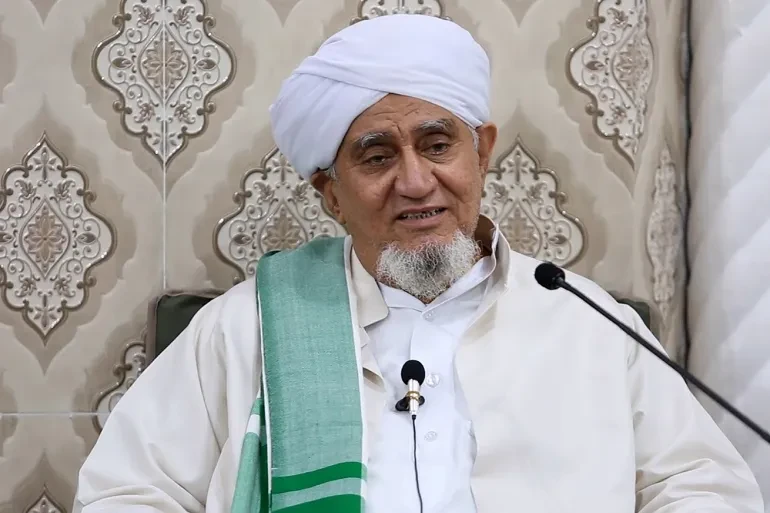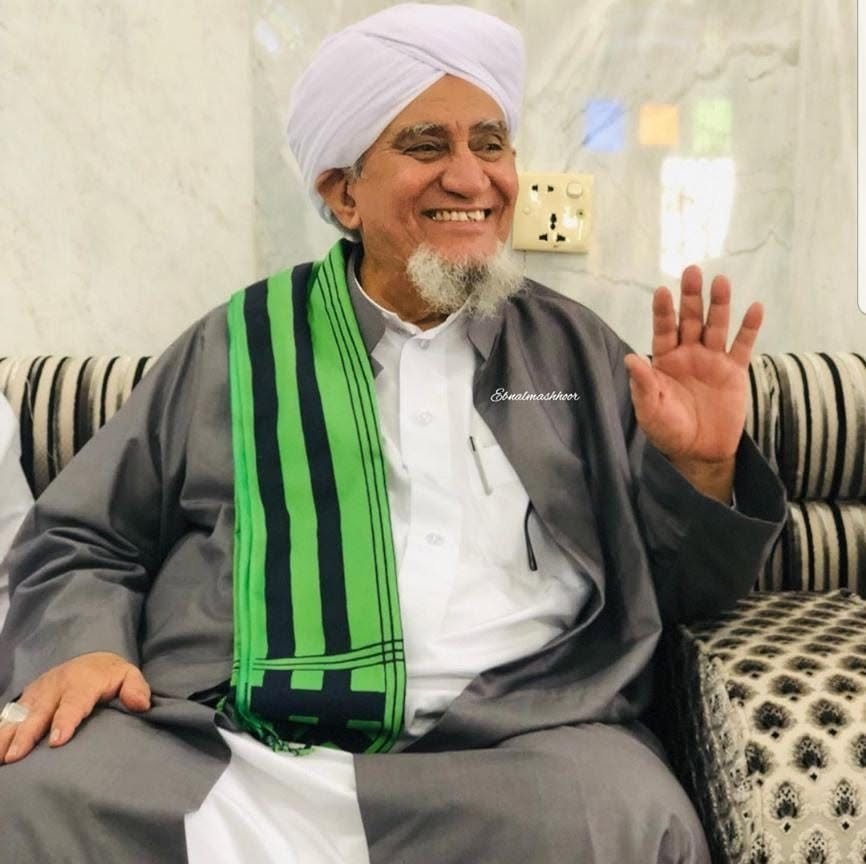

Sayyid Abu Bakr bin Ali al-Mashhur
Scholar Born: 1947, Ahwar – Abyan Governorate – Yemen Died: 27 July 2022
Abu Bakr al-Adani bin Ali al-Mashhur, a Hadrami scholar, preacher and author, was born in the city of Ahwar in Abyan Governorate in 1947. He belonged to a family with Hadrami roots. He was known for his work in education and religious guidance, and founded a number of institutions and scientific centers, most notably the Islamic Education Rabats. He left behind works addressing Islamic jurisprudence, history and thought before his death in 2022.
Biography
Birth and upbringing
Abu Bakr al-Adani bin Ali bin Abi Bakr bin Alawi al-Mashhur was born in 1366 AH, corresponding to around 1946–1947, in the city of Ahwar in Abyan Governorate. He belonged to the Al Ba Alawi family, which has Hadrami origins.
He grew up in a family with an interest in Islamic religious sciences, memorized the Holy Quran under his father’s tutelage, and received his primary education in Ahwar and Al Mahfad before moving to the city of Aden to continue his studies.
Education and scholarly formation
Al-Mashhur combined traditional religious education with modern academic studies. He enrolled in the Faculty of Education at the University of Aden, where he studied Arabic language and literature.
He studied Islamic religious sciences under a number of scholars in Yemen and Saudi Arabia, most notably Al-Habib Abdul Qadir bin Ahmad al-Saqqaf, whose approach to education and upbringing influenced him.
Educational and preaching career
He began his professional life as a teacher in schools in Ahwar and Aden, then moved to Saudi Arabia around 1980, where he lived for approximately twelve years and worked as an imam and preacher at a number of mosques in Jeddah.
During his stay in Saudi Arabia, he continued his studies in Islamic religious sciences and participated in scholarly and educational gatherings.
Founding the Islamic Education Rabats
After returning to Yemen, he set about establishing educational and religious institutions known as the “Islamic Education Rabats,” which spread across a number of Yemeni governorates.
These institutions aimed to teach Islamic religious sciences and Arabic, train students and teachers, and organize educational and social activities.
He also contributed to establishing research and study centers, as well as educational institutions in Hadramout and other areas.
Scholarly and intellectual activity
Al-Mashhur was known for his writings on Islamic education and the jurisprudence of preaching, and for presenting scholarly and intellectual concepts, most notably “the jurisprudence of transformations,” “the principle of positions” and “the principle of indication.”
He presented these concepts in his books and lectures as a framework for understanding social and intellectual transformations from a religious perspective.
He was also interested in history, biographies, literature and poetry, and published a large number of books, treatises and poetic works.
Role in university education
His name was associated with the University of Wasatiyyah for Islamic and Human Sciences in Hadramout, which he headed, as well as his general supervision of the Islamic Education Rabats and their educational and vocational centers.
Death
Abu Bakr al-Adani bin Ali al-Mashhur died on Wednesday, July 27, 2022, corresponding to 28 Dhu al-Hijjah 1443 AH, in the Jordanian capital, Amman, where he was receiving treatment.
His body was transported to Hadramout, and he was buried in Zanbal Cemetery in the city of Tarim on Friday, July 29, 2022.
He left a legacy of books, educational institutions and students, as well as recordings of his lectures and scholarly lessons.
Works
1. Founding the Islamic Education Rabats He established a network of institutes and educational centers in a number of Yemeni governorates to teach Islamic religious sciences, Arabic and Islamic education. 2. Contributing to the founding of the University of Wasatiyyah for Islamic Studies His name was associated with the founding and development of the University of Wasatiyyah for Islamic and Human Sciences in Hadramout, which he headed. 3. Writing on Islamic religious and intellectual sciences He published dozens of books and scholarly treatises addressing jurisprudence, education, preaching, history and biographies. 4. Introducing the concept of the jurisprudence of transformations He presented a number of intellectual propositions concerning the understanding of social and historical transformations, and discussed them in his books and lectures. 5. Contributing to education and teaching He worked as a teacher in schools in Ahwar and Aden, then as an imam and preacher in Jeddah, before devoting himself to supervising educational and preaching institutions. 6. Founding scholarly and vocational centers He contributed to establishing research, study and vocational training centers, alongside religious and educational institutions. 7. Literary and poetic activity He wrote poetry and literary works, and published collections and stories addressing social, intellectual and religious topics. 8. Documenting history and biographies He authored books about the history of Yemeni regions and the lives of scholars and scholarly figures, including works on the history of Ahwar and notable figures of Hadramout.
Photos