
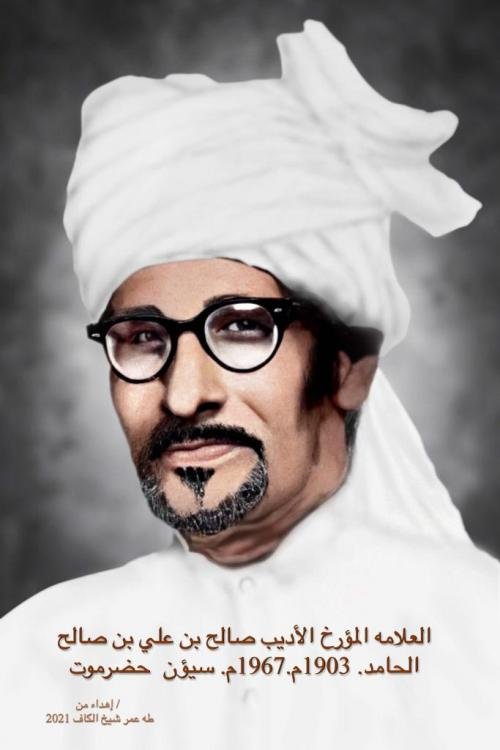
Saleh bin Ali bin Saleh Al-Hamid
Poet Born: 1903, Seiyun District Died: 13 June 1967 Sayun
Saleh bin Ali Al-Hamid was a Hadrami poet, historian, jurist and judge. He was born in the city of Seiyun in 1903 and is considered one of the pioneers of the literary and intellectual renaissance in Hadramout during the 20th century. He combined poetry with historical writing and Islamic legal research, and held judicial positions in the Kathiri State. He was known for his poetry collections “Nesmat Al-Rabee,” “Layali Al-Maseef” and “Ala Shati Al-Hayat,” as well as his book “History of Hadramout.” He died in Seiyun in June 1967, leaving behind a prominent scholarly and literary legacy.
Biography
Birth and Upbringing in Seiyun
Saleh bin Ali bin Saleh Al-Hamid was born in 1903 in the city of Seiyun in Wadi Hadramout, which was then the capital of the Kathiri Sultanate.
He grew up in a family known for its interest in scholarship, charitable work and trade. His father, Ali bin Saleh Al-Hamid, was among the Hadrami businessmen whose commercial activities were connected to Southeast Asia.
His mother was of Hadrami descent and was born in Indonesia, reflecting the social and commercial ties that connected Hadramout with Hadrami migrant communities at the time.
His father took an interest in his education from childhood, encouraged him to read and learn, and provided him with a wide range of books that helped shape his scholarly and literary character.
Education and Scholarly Formation
Al-Hamid began his education by memorizing the Holy Quran and studying the principles of reading, writing and Islamic sciences at Seiyun’s traditional Quranic schools.
He then joined the religious school of the scholar Muhammad bin Hadi Al-Saqqaf, where he studied Shafi‘i jurisprudence, Hadith, grammar and Arabic language sciences.
He showed notable aptitude in grammar, and his teacher gave him the title “Sibawayh of the Zawiya,” in recognition of his excellence in Arabic grammar.
He also studied under Abdul Rahman bin Ubaidullah Al-Saqqaf, one of Hadramout’s most prominent scholars and historians, benefiting from his gatherings on literature, rhetoric and jurisprudence.
Among his classmates during his education were several figures who later became prominent in scholarly and literary life, including Ali Ahmed Bakathir, Muhammad bin Sheikh Al-Masawi, Aidarus bin Salim Al-Saqqaf and Mustafa bin Salim Al-Saqqaf.
His Interest in Reading and Book Collecting
His family’s comfortable financial circumstances enabled him to build a large personal library, containing works on jurisprudence, Hadith, history, literature, language, philosophy and politics.
His father imported books and publications for him from abroad, at a time when modern books were not readily available in Hadramout’s cities.
His library became an important center for reading, research and discussion, and was used by a number of scholars and writers who visited his home.
The library’s significance lay not only in the works it contained, but also in its role in encouraging cultural exchange among Seiyun’s intellectuals.
Part of its collection was later transferred to Al-Ahquaf Library in Tarim, according to published accounts of the library’s history.
Journeys to Singapore and Indonesia
Saleh Al-Hamid traveled to Singapore in 1923, and the trip marked the beginning of his direct connections with Hadrami communities in Southeast Asia.
Some of his journeys were intended to follow up on his father’s commercial and real-estate interests, but he also used them to learn about the cultural and social life of Hadrami migrants.
He traveled repeatedly to Singapore and Indonesia and visited several cities and islands, including Java, Surabaya and Bandung.
During his journeys, he took an interest in documenting the lives of Hadrami migrants, their history of settlement in the region, and their commercial, educational and cultural activities.
He was also influenced by Indonesia’s tropical nature and geographical landscapes, and these influences appeared in his poems about beauty, nature and human life.
He recorded some of his observations in his book known as “The Beautiful Journey to Java” or “My Journey to Indonesia.”
His Early Poetry and Appearance in the Arabic Press
Saleh Al-Hamid emerged as a poet during the first decades of the 20th century and began publishing his poems and articles in a number of Arabic newspapers and magazines.
The most prominent magazines to publish his work included “Al-Risala” and “Apollo” in Egypt, as well as newspapers and magazines published in Indonesia and Singapore.
He also took part in Hadrami literary life through gatherings, forums and poetic exchanges.
His interest in poetry was wide-ranging: he wrote about love, nature, homeland, history and social issues, combining traditional Arabic styles with modern literary trends.
His poetry was associated with the Romantic movement, which spread widely in Arabic literature during the 1930s.
Publication of “Nesmat Al-Rabee”
Saleh Al-Hamid published his first poetry collection, “Nesmat Al-Rabee,” in Cairo in 1936, through the Committee for Composition, Translation and Publishing Press.
The collection’s publication was an important milestone in the history of Hadrami poetry, coming at a time when publication of modern poetry collections was limited in Yemen.
The collection attracted the attention of Egyptian writers, and poet Ahmed Rami wrote verses to introduce it.
A number of critics consider Al-Hamid to have been among the first Yemeni poets to publish collections with individual titles and poems featuring a modern artistic structure.
The collection was also known for its use of poetic imagery and emotive language, and for expressing nature and human feelings.
His Relationship with the Apollo Literary School
Al-Hamid was influenced by the Romantic current in Arabic poetry, particularly the trend represented by Egypt’s Apollo literary group.
This influence was reflected in his interest in nature, beauty, human feelings and personal experience.
He published some of his work in “Apollo” magazine and formed literary connections with a number of Arab poets and writers.
Nevertheless, his poetry retained the characteristics of the Arabic language and the literary heritage of his Hadrami environment.
He is therefore considered one of the poets who contributed to the transition from traditional poetry to forms of expression more focused on emotional experience.
“Layali Al-Maseef” and His Emotional Experience
In 1950, he published his second collection, “Layali Al-Maseef,” in Cairo.
The collection included emotive and romantic poems in which his human experience appeared more clearly.
Literary studies note that some of his poems were connected to significant personal experiences, including the death of one of his wives at a young age.
Those poems reflected feelings of grief, loss and longing, alongside themes of love, beauty and nature.
The collection became one of the prominent works discussed by critics studying the Romantic trend in Hadrami poetry.
His Relationship with Artists and Hadrami Song
Saleh Al-Hamid’s influence was not limited to written poetry, but also extended to Hadrami song.
Artist Muhammad Jum‘a Khan composed and sang a number of his poems, most notably the poem known as “Zahrat Al-Husn,” which begins with the line “Stand with me, let us witness beauty.”
A number of Hadrami and Arab artists also sang some of his poems, and he formed relationships with musicians in Hadramout and Indonesia.
The poet and musician Sheikh Al-Bar played a role in composing some of his works during his journeys to Southeast Asia.
Setting his poems to music helped bring his poetry to a wider audience beyond readers and those interested in literature.
His Journey to Egypt and Cultural Connections
Saleh Al-Hamid visited Egypt in 1953, where he met a number of writers and intellectuals.
Among the most prominent figures with whom he was associated was the Hadrami writer and novelist Ali Ahmed Bakathir, with whom he shared an old friendship that began when they were students in Seiyun.
The journey enabled him to connect directly with Egypt’s literary life, after having been in touch with it through correspondence and publication in magazines.
He also followed Arab literary activity and took an interest in discussions on the development of poetry, criticism and history.
His Contributions to Writing the History of Hadramout
Alongside poetry, Saleh Al-Hamid was interested in writing history, particularly the political, social and cultural history of Hadramout.
Among his most prominent works is “History of Hadramout,” which covers periods in the region’s history from ancient times through later periods of its Islamic history.
He drew on his reading of historical sources and local accounts, as well as comparing reports and consulting biographical and genealogical works.
The book was published in two volumes after his death and became one of the references used in the study of Hadrami history.
The book’s significance lies in its attempt to present a coherent historical narrative, while focusing on figures, events, and political and social changes.
His Judicial Work in the Kathiri State
Saleh Al-Hamid held judicial responsibilities in the Kathiri State during the final years of the sultanate’s rule in Hadramout.
He served as president of the Court of Appeal, a Sharia adviser and a judicial representative on the Kathiri State Council.
In his work, he drew on his jurisprudential education and knowledge of the Shafi‘i school, as well as his interest in comparing legal opinions and interpretations.
He also took part in discussions on laws and judicial procedures and sought to develop some of the legal frameworks governing the work of institutions.
Among his most notable activities was participating in the preparation of a draft criminal code for the Kathiri State, a project that prompted discussion among scholars and those interested in judicial affairs.
His Role in the Kathiri State Constitution Project
In August 1965, Saleh Al-Hamid chaired a committee tasked with preparing a draft constitution for the Kathiri State.
The committee included legal and administrative figures and discussed several issues relating to the organization of powers and government institutions.
This assignment highlights his role in the administrative and legal reform efforts undertaken by the sultanate during its final years.
The preparation of the draft must be distinguished from the adoption of an effective constitution; the available information is insufficient to establish that the draft became a constitution formally brought into force.
His Work in Education and Social Reform
Al-Hamid was interested in developing religious education and called for the establishment of educational institutions to help prepare judges, teachers and specialists in Islamic sciences.
In 1960, he sought to support a religious institute project in Seiyun and later took part in initiatives to establish an institution specializing in religious studies.
He believed in the importance of developing and organizing education to meet the needs of society and its institutions.
He also took part in social and cultural life and was known for participating in discussions on public affairs.
His Cultural Forum in Seiyun
Saleh Al-Hamid set aside a weekly gathering at his home in Seiyun, known as the “Al-Tawilah Forum.”
The gathering welcomed scholars, writers and social figures, and discussions covered religious, literary, historical and political subjects.
He also regularly held scholarly gatherings during Ramadan, which included recitations of the Holy Quran and interpretations of some of its verses.
His home became a place for cultural and social exchange in Seiyun, at a time when private forums played an important role in sharing knowledge.
Death and Historical Legacy
Saleh bin Ali Al-Hamid died in Seiyun in June 1967 following a sudden health problem, after a career that combined literature, judicial work, history and public service.
Sources differ on the exact day of his death: some give June 13, while others give June 14, 1967.
He left behind a collection of books, poetry collections, manuscripts and letters, as well as a large scholarly library.
Interest in his legacy continued after his death. Some of his works were published in later editions, and events and seminars were held to study his work.
In June 2007, the Union of Yemeni Writers and Authors in Wadi Hadramout, in cooperation with his family, organized events marking the 40th anniversary of his death. They included an exhibition of his manuscripts, photographs and works, as well as a scholarly seminar on his output.
His legacy remains present in literary and historical studies addressing the intellectual renaissance in Hadramout during the 20th century.
Works
1. Pioneering modern Hadrami poetry: He was among the first Hadrami poets to publish collections in a modern style and introduce new subjects and emotional experiences into poetry. 2. Authoring “History of Hadramout”: He produced a two-volume historical work that became a reference used in the study of the region’s history. 3. Judicial work in the Kathiri State: He served as president of the Court of Appeal and held roles as a Sharia adviser and judicial representative on the State Council. 4. Chairing the committee to prepare a draft constitution in 1965: He took part in efforts to develop the legal and administrative system of the Kathiri State. 5. Developing jurisprudential studies: He left research and commentaries addressing the Prophet’s Hadith and comparative jurisprudence. 6. Documenting Hadrami migration: He recorded aspects of the social and cultural lives of Hadrami migrants in Southeast Asia. 7. Promoting cultural life in Seiyun: He hosted a weekly forum bringing together scholars, writers and social figures. 8. Contributing to Hadrami song: He wrote lyrics performed by artists, most notably Muhammad Jum‘a Khan. 9. Participating in the Arab literary press: He published poems and articles in Egyptian magazines and newspapers of the Hadrami diaspora. 10. Supporting religious education: He backed initiatives to establish institutions for training students and specialists in Islamic sciences.