Sewage Overflow in Seiyun: Residents’ Suffering, Overlapping Responsibilities and a Stalled Sanitation Project
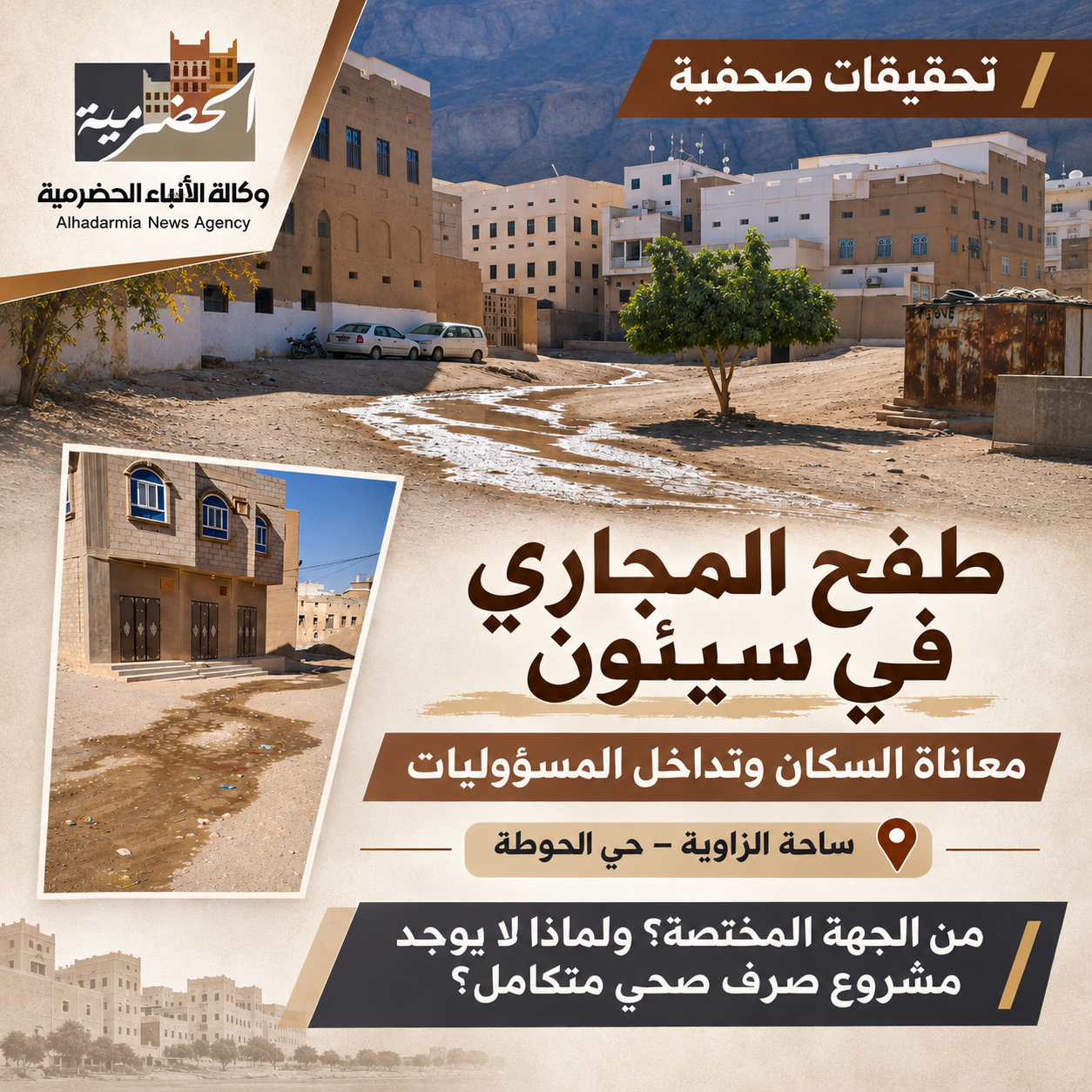
Seiyun | Alhadarmia News Agency | Investigative Reports
A complaint filed by residents living around Al-Zawiya Square in the Al-Hawtah neighborhood of Seiyun has brought the sewage issue back into the spotlight, amid the continued flow of wastewater through public streets and differing views on which authorities are responsible for addressing the problem. Questions have also been raised about why the city still lacks an integrated sewage system project.
Alhadarmia News Agency reviewed a number of posts and comments related to the issue, seeking to shed light on residents’ suffering, clarify the position of the Water and Sanitation Corporation, and examine aspects of the problem that extend beyond Al-Zawiya Square.
Residents’ Complaint and Health and Environmental Concerns
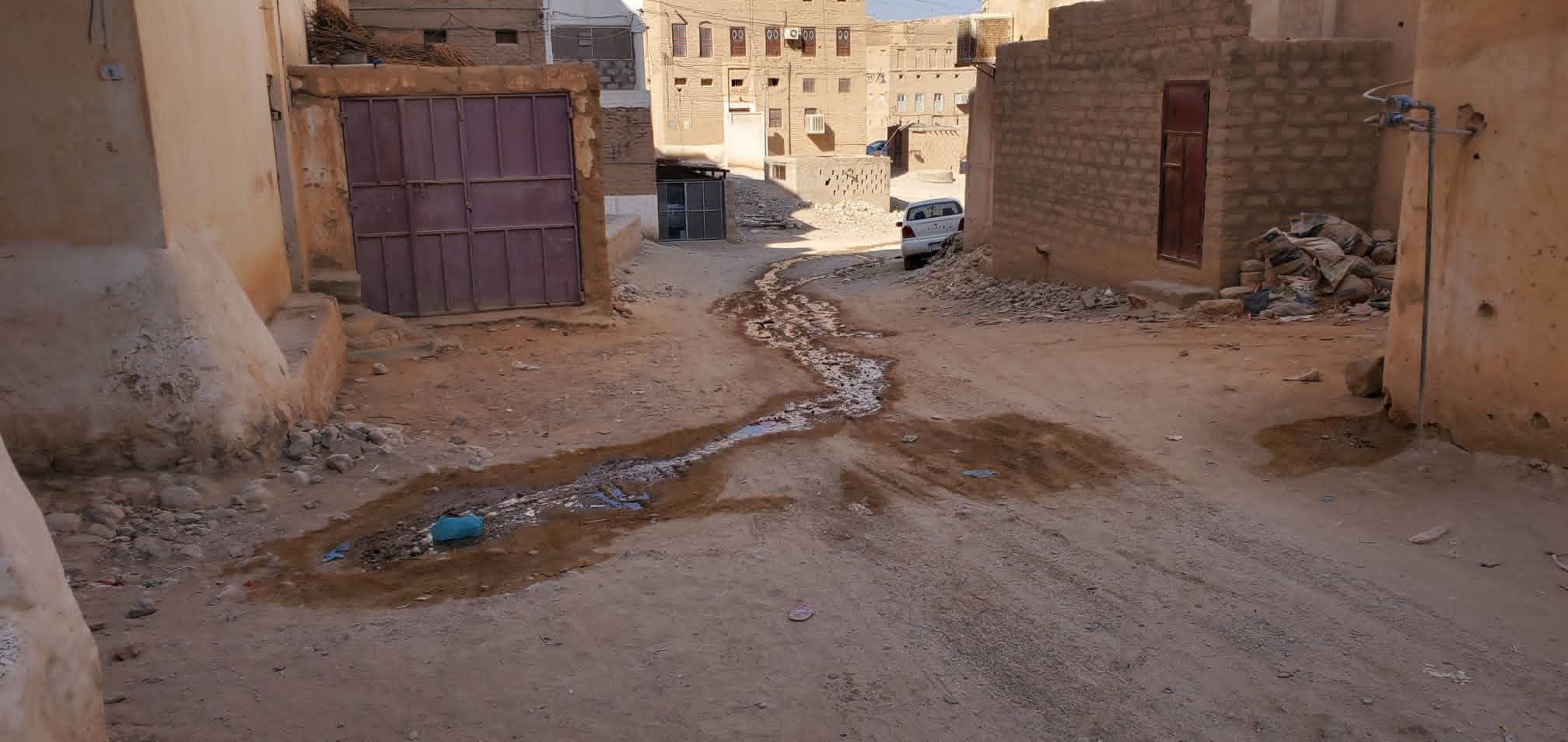
Alhadarmia News Agency reviewed a post published by Saleh Faraj that included a complaint dated November 24, 2026, submitted by residents living around Al-Zawiya Square in the Al-Hawtah neighborhood to the Director General of the Local Corporation for Water and Sanitation in Wadi Hadramout and the Director General of Seiyun District. The complaint concerned the continued flow and pooling of wastewater in the square and surrounding streets for several days.
In their complaint, residents pointed to the health and environmental damage caused by the water, the obstruction of traffic and pedestrians, the spread of foul odors and disease-carrying insects, and their concerns that the foundations of nearby homes and shops could be affected. The square is particularly close to the women’s market, in a populated area with commercial activity.
Residents called for an urgent field inspection to identify the source of the water, repair the fault and drain the stagnant water, in order to protect public health and residents’ safety.
Water Corporation Clarifies the Limits of Its Responsibility
As part of its follow-up on the issue, Alhadarmia News Agency noted a comment by Nabil Hadi Ba Hashwan, Director of the Seiyun branch of the Local Corporation for Water and Sanitation, in response to the post. He said that the water shown in the photographs came from a sewer line belonging to a resident’s home, and was not caused by a fault in the corporation’s main network, according to his statement.
Ba Hashwan stressed that the corporation is not responsible for residents’ internal networks and septic tanks, noting that other authorities are tasked with requiring residents to address water leaks originating from their homes.
He explained that the corporation’s responsibility is limited to the main networks and tanks, including their maintenance and rehabilitation when necessary. He added that the corporation bears significant financial burdens in the area of sanitation in order to preserve the environment and the general appearance of Seiyun.
He added that blockages may occur from time to time, but the corporation works to address them as quickly as possible.
No Integrated Sewage Project
In the same context, Alhadarmia News Agency noted a post by Ali Bas'eidah titled “At Least… Don’t Blame It!” in which he addressed criticism directed at the Water and Sanitation Corporation, calling for a distinction between problems that fall within the corporation’s remit and those caused by residents’ private sewer lines.
Bas'eidah said that the corporation contracts with the private sector to pump out sewage on a daily basis and incurs financial costs in order to preserve the environment and keep the city clean.
However, the most prominent point in his post was that Seiyun and the cities of Wadi Hadramout in general still lack an integrated sewage project. He explained that the project had stalled for reasons he said were beyond the corporation’s control, without specifying the nature of those reasons or the authorities responsible for the delay.
Who Is Responsible for Addressing the Wastewater?
While the director of the Seiyun branch of the Water Corporation defined the scope of the corporation’s responsibility and said that other authorities are tasked with requiring residents to repair leaks, he did not name those authorities or explain their remit and intervention mechanisms in his comment.
This highlights one of the key issues that requires clarification: if the Water Corporation is not responsible for residents’ private sewer lines, which authority is responsible for clearing up the effects when wastewater flows into public streets and squares? Who is responsible for requiring those at fault to fix the problem? And which authority should affected residents approach with their complaints?
Identifying the source of the problem, although important, is not enough on its own to address its effects. When water flows from private property into public spaces, it becomes an issue affecting public health, the environment and residents’ safety.
There remains a need for the relevant authorities to provide an official clarification on the division of duties and responsibilities, ensuring that residents are not left facing a problem about which there are differing explanations, without clarity on which authority is tasked with addressing it.
The Sewage Project… The Bigger Issue
Beyond the scope of direct responsibility in the Al-Zawiya Square incident, a more important issue emerges: the lack of an integrated sewage project in Seiyun, as Bas'eidah pointed out.
Why does a city the size of Seiyun, with its administrative, commercial and population standing, still not have an integrated sewage project? What are the real reasons for the project’s delay? Which authorities are responsible for funding and completing it? Is there a clear plan with a defined timeline for its completion?
There is also a need to disclose the amount spent on sewage pumping and temporary measures, and whether it is possible to move from these measures to sustainable solutions that limit the recurrence of the problem.
How Long Will Temporary Measures Continue?
The Al-Zawiya Square case highlights the need for a broader response to the sewage issue in Seiyun, beginning with a clear definition of responsibilities and areas of authority, and extending beyond repairing leaks or pumping water that has collected in the streets.
Based on the material reviewed by Alhadarmia News Agency, it was not possible to independently verify the source of the water in the field or determine whether the problem had been resolved. The published statements also did not provide a detailed explanation of the reasons for the delay to the sewage project or a timeline for its completion.
Between residents’ complaints and the Water Corporation’s explanations, the sewage issue still requires greater transparency, a clear definition of responsibilities and serious action to complete the integrated project, as one of the city’s essential service and environmental needs.
Seiyun residents have the right to know which authority is responsible for addressing these problems. They also have the right to know why the sewage project has stalled and when their city will move from temporary measures to sustainable solutions.
Read also