
Teacher Salary Crisis Places Education in Hadramout Before Mounting Challenges
During the 2023–2024 school year, the education sector in Hadramout saw a worsening crisis in teachers’ living conditions, as the real value of salaries declined amid rising prices and the deterioration of the local currency. This brought demands for improved wages and incentives to the forefront of the education scene. These developments coincided with challenges facing schools in providing the staff and resources needed to keep the educational process going. The relationship between teachers’ rights and the regularity of classes became one of the sector’s most prominent concerns, before developing into union actions and strikes during 2024.
Historical Background
The teachers’ crisis in Hadramout did not begin suddenly in 2024. Rather, it was an extension of financial and administrative challenges that had accumulated over the years of war, most notably the declining purchasing power of wages, the halt in regular government hiring, and growing reliance on contract teachers to fill shortages in schools.
According to a report published by the Sana’a Center for Strategic Studies in April 2024, education authorities resorted to temporary contracts to meet growing needs, following the retirement of a number of teachers, the opening of new schools, and difficulties with official recruitment.
The report noted that some contract teachers received monthly salaries ranging from 45,000 to 55,000 Yemeni rials, depending on their qualifications, with payments delayed in some cases. It also cited an estimate of around 17,000 contract teachers—men and women—since 2016, reflecting the extent of reliance on this group.
Event Details
2023: Living Pressures and Staff Shortages
During 2023, it became increasingly difficult to reconcile teachers’ wages with the cost of living amid rising prices and declining purchasing power.
The challenges were not limited to employees in permanent government positions; they also affected contract teachers, who faced wage disparities and a lack of job security.
According to the Sana’a Center report, low wages prompted some teachers to seek additional work, affecting the time available for teaching and professional development. The retirement of teachers and the opening of new schools also increased the need for additional educational staff.
February 2024: Living-Condition Demands Turn into Protests
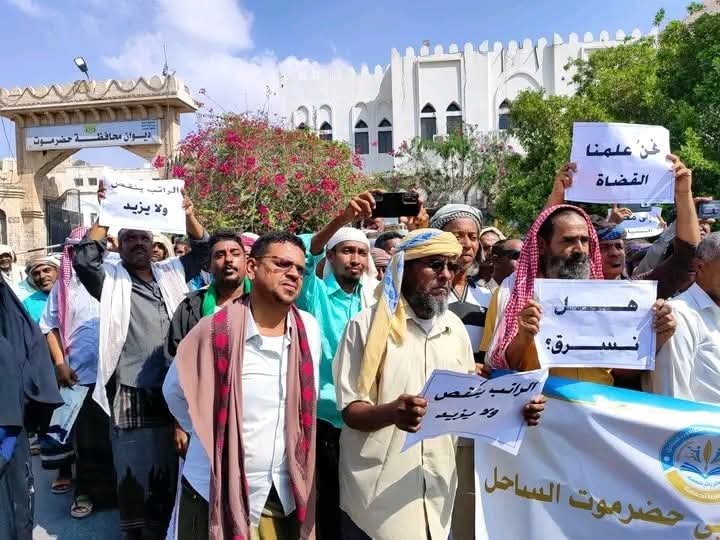
On February 4, 2024, teachers in Hadramout began protest actions by wearing red armbands, according to union statements published by local media, in preparation for a partial strike on the sixth and seventh of the same month.
The demands centered on regular salary payments, approval of a cost-of-living allowance of 50,000 Yemeni rials, settlement of outstanding allowances, and a review of the wage structure to reflect economic changes.
On February 11, a widespread strike began in a number of schools in Wadi and Desert Hadramout and extended to some coastal districts, resulting in the suspension of classes at schools covered by the strike. No unified, documented count of all affected schools was available.
April 2024: Disputes over Salaries and Continued Strike
On April 2, the Yemen Shabab Net website reported that the Education Office in the Hadramout Coast had required some teachers to sign an undertaking not to strike in order to receive their February salary, according to a document the website said it had reviewed.
The incident highlighted escalating disagreement over how to handle the strikes, between teachers’ demands for their financial rights and education authorities’ commitment to resuming classes.
On April 21, the payment of incentives and allowances to permanent and contract teachers, starting from March, was announced. However, this did not immediately end the disputes, as union actions continued in the following period.
May–July 2024: Negotiations and Agreement to End the Strike
On May 11, union committees in Wadi Hadramout announced that they had coordinated with teacher representatives in the coastal area on a set of joint demands, including increasing incentives, regularizing the status of contract teachers, and addressing delayed settlements and allowances. They noted that disagreement over the proposed incentive amount continued.
On June 24, the Hadramout Coast Teachers’ Committee announced the suspension of the strike in relation to the secondary school certificate examinations, and the return of secondary school teachers to schools as of June 25 to review lessons with students. The step followed mediation and contacts with the local authority.
The Hadramout Teachers’ Committee then announced on July 20, 2024, that it was ending the strike that had begun on February 11, following an agreement with the local authority. The agreement included payment of a monthly incentive to permanent and contract teachers, work to regularize the status of contract teachers, and the formation of a preparatory committee for new union elections.
Educational and Social Impact
The crisis demonstrated how closely educational stability is linked to teachers’ living conditions, as ongoing financial disputes affected the regularity of classes in a number of schools and raised concerns about academic achievement and completion of the curriculum.
The crisis also exposed a structural problem that goes beyond the issue of increasing salaries: the growing reliance on contract teachers without a comprehensive resolution of their employment circumstances.
Although the July 2024 agreement ended the strike announced at the time, the agreement does not constitute evidence that all financial and administrative problems in the education sector have been resolved.