
A one-megawatt solar power station enters the final preparations phase to operate Falak Water Field in Mukalla
On August 19, 2024, the solar power station project designated to operate the Falak well field in Mukalla reached the final preparations stage, with a production capacity of one megawatt and funding from the local authority in Hadramout Governorate. The project aimed to reduce reliance on conventional electricity and diesel fuel, and to strengthen the stability of operations at one of the city’s largest drinking-water sources, which, according to data announced at the time, comprised 16 wells with a production capacity of up to 640 cubic meters per hour.
Falak Field... a key source of water supplies for Mukalla
The Falak well field is one of the most important drinking-water sources relied upon by Mukalla, alongside the Al-Naq'ah and Thillah fields, in a water system that requires pumps to operate regularly to ensure water reaches residential neighborhoods.
According to information announced by the local authority in August 2024, the field comprised 16 wells that together produced about 640 cubic meters of water per hour and supplied wide areas of the city, reaching as far as the west of Al-Dhiyafah.
This production capacity made the field one of the vital facilities linked to the stability of drinking-water supplies in Mukalla, particularly amid rising household demand for water and the need to ensure the wells continue operating.
The project’s origins... an agreement dating back to 2021
The solar energy project for Falak Field did not begin in August 2024; contractual procedures dating back to 2021 preceded it.
At that stage, the local authority in Hadramout Governorate signed a contract to build a one-megawatt solar power station for the field, at an announced cost of $900,000, with implementation assigned to the Integrated Solutions for Solar Energy Systems Foundation.
According to the contract announcement, the project included operating 13 wells using a remote-control system, with an expected reduction in electricity and diesel consumption of between 30 and 40%.
The project’s primary aim was to reduce the field’s reliance on conventional energy sources and ease the operational burden associated with providing fuel and maintaining a stable electricity supply.
August 19, 2024... the project reaches the final preparations stage
On Monday, August 19, 2024, the local authority in Hadramout Governorate announced that the solar power station project had reached the stage of completing final preparations.
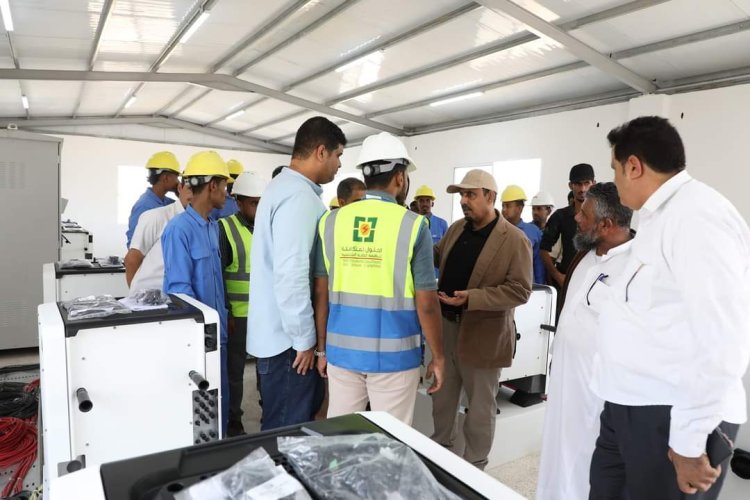
The announcement came during a visit by the governor of Hadramout at the time, Mabkhout Mubarak bin Madi, to review progress on the station’s installation work, in the presence of officials from the local water and sanitation corporation and the relevant technical authorities.
The governor listened to an explanation from engineers about the progress of technical work and the station’s preparations to enter the operational phase.
This stage represented significant progress on the project after years had passed since the announcement of the contract to build it, but it does not mean that the station had actually begun operating the wells at full capacity on that date.
Saving more than 45,000 liters of diesel per month
One of the station’s most prominent announced objectives was to reduce diesel fuel consumption for operating the water system.
According to estimates by engineers cited by the local authority, the project was expected to save more than 45,000 liters of diesel per month by replacing some conventional energy with electricity generated by solar panels.
This aspect is especially significant given the high costs of operating water wells and the reliance of some pumping facilities on fuel to run generators when the electricity supply is interrupted.
Reducing diesel consumption could also help lower the operating expenses of the local water corporation and make the field less vulnerable to disruptions in fuel supplies.
However, the announced savings are an expected estimate upon the project’s operation, not an amount that had been confirmed as saved in August 2024.
Solar energy as a solution for water stability
The project is part of an effort to operate water fields using renewable energy sources, after repeated disruptions to supplies caused by electrical faults and power outages.
Its importance is evident in three main areas: reducing reliance on diesel, lowering operating expenses, and strengthening the corporation’s ability to keep pumping water during hours when solar energy is available.
However, the station alone does not address all the causes of the water crisis; the regularity of supplies remains dependent on the condition of the wells, pumps and transmission lines, as well as the availability of the energy needed to operate them at night or during periods of low solar radiation.
Did the station enter service in August 2024?
Reports published on August 19 confirm that the project had reached the final preparations stage, but they do not include a clear announcement that commercial operations or full operations of all the wells had begun.
Therefore, this date should not be treated as the station’s opening date, nor should the announced financial savings be considered definitively achieved.
I also did not find, among the sources I reviewed, sufficient subsequent operational data to determine the amount of additional water pumped thanks to the station or the extent to which the hours when water reached residents’ homes improved.
The impact on the course of the water crisis in Hadramout
Progress on the Falak Field project marks an important milestone in developing Mukalla’s water system, because it is linked to one of the city’s largest sources of water production and seeks to address reliance on electricity and diesel as factors affecting the continuity of pumping.
This project differs from routine maintenance work: it is an investment in the energy infrastructure used to produce water, and it could have long-term effects once completed and operated efficiently.
However, assessing its actual impact depends on documenting the date it entered service and the results of its operation, not merely announcing that its work is close to completion.